Iridium & Platinum Catalysts for PEM Electrolysis
Advanced precious metal catalyst solutions for sustainable hydrogen production via PEM water electrolysis and related technologies. The Heraeus portfolio includes highly efficient iridium-based catalyst and platinum catalyst systems designed to maximize performance and long-term stability.
PEM Anode Catalysts (OER)
Heraeus offers a comprehensive range of anode materials for PEM electrolysis, including advanced iridium catalysts and iridium catalyst technologies. These systems are optimized for outstanding catalytic activity and stability under demanding operating conditions.
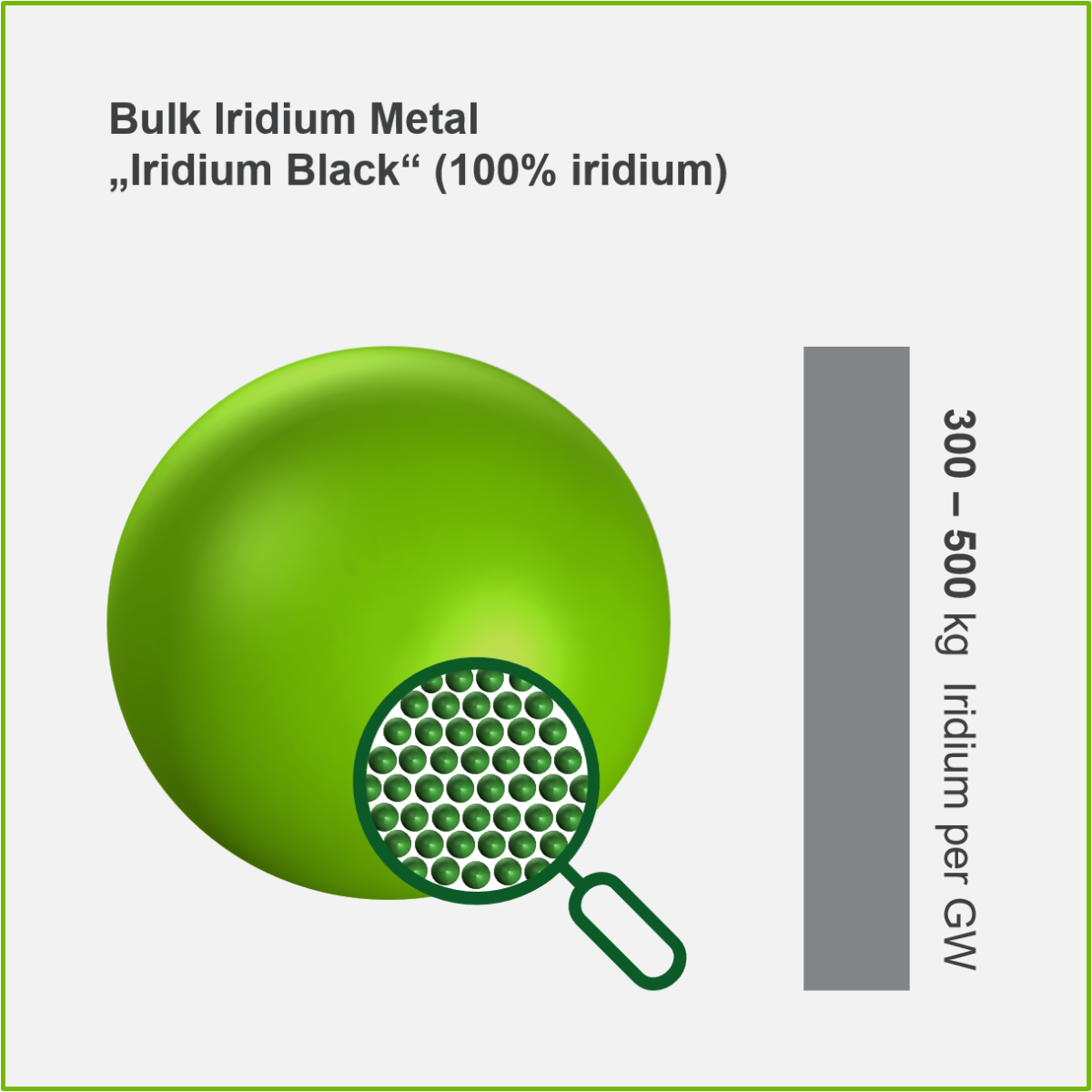
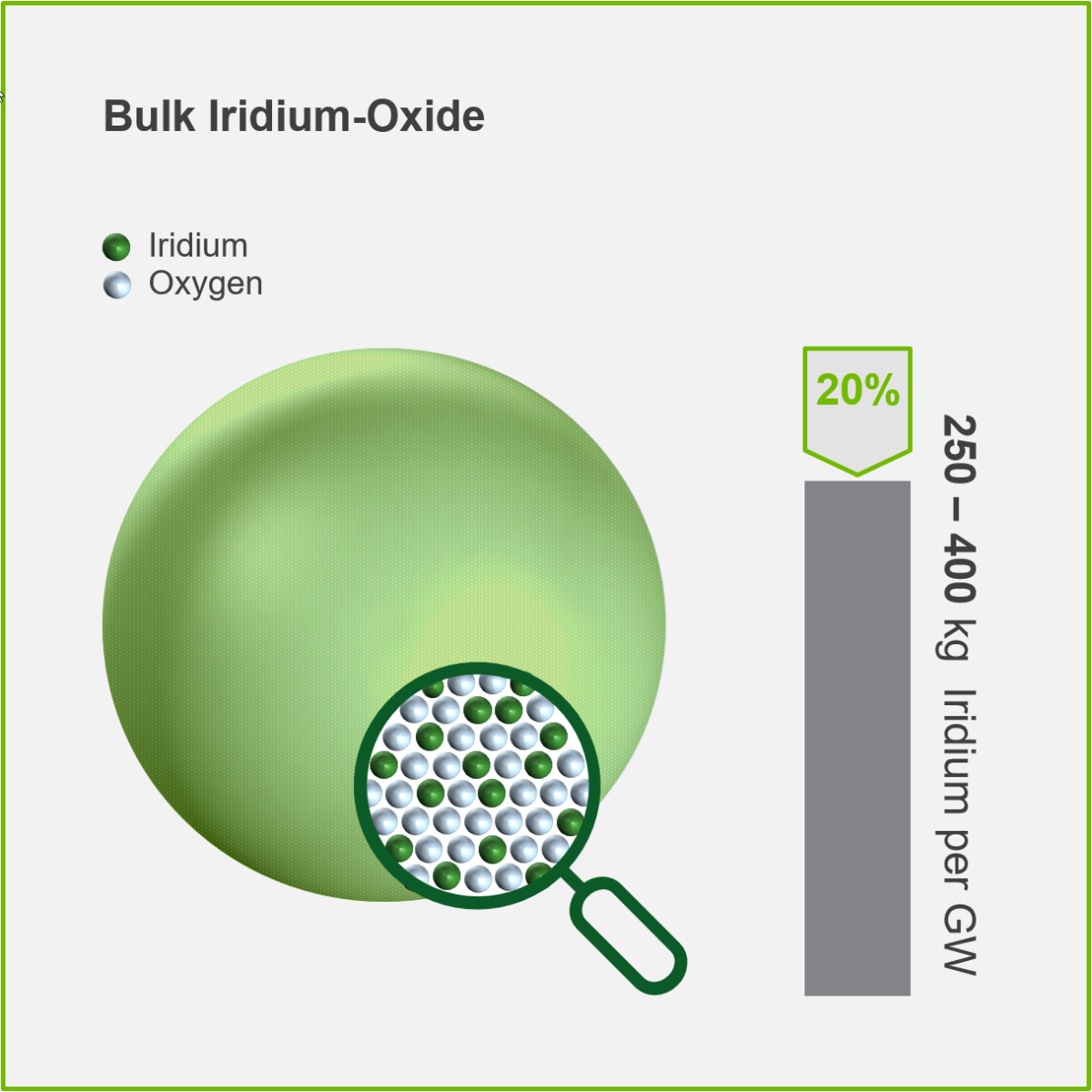
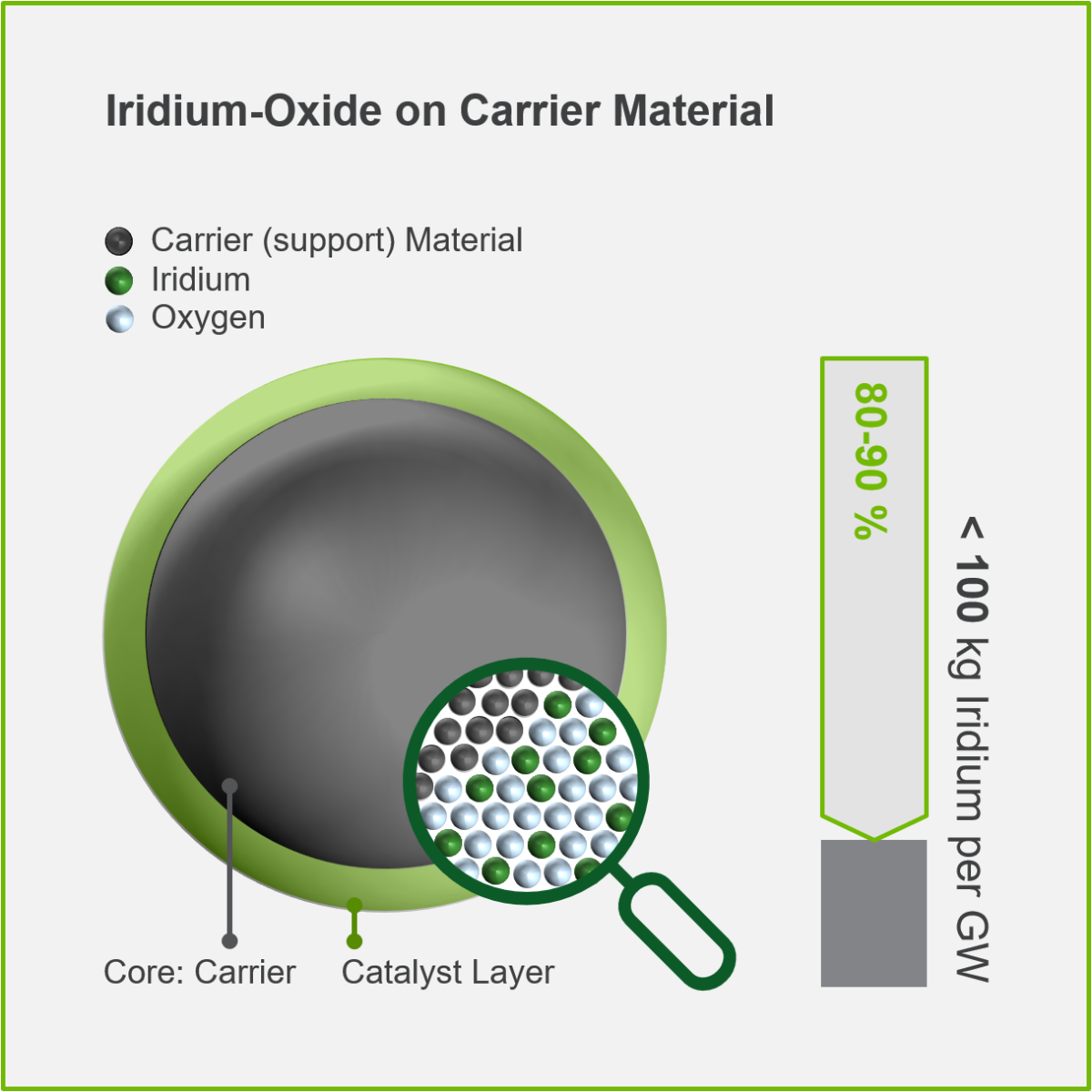
Our portfolio features innovative precious metal catalyst formulations based on tailored iridium compounds and oxide structures, ensuring efficient oxygen evolution and robust stability. Through extensive validation in our fully equipped laboratories and test center, we evaluate performance to ensure maximum reaction efficiency in industrial applications. This behavior is closely linked to the atomic structure of the catalyst material.
|
Catalyst |
Actydon | |
Actydon | |
Actydon | |
Actydon | |
Actydon | Ir Ru |
|---|---|---|---|---|---|
| Features |
High metal purity |
High surface area |
Smaller agglomerate size for better processability |
High mass activity |
With stabilized Ru for high activity and Ir saving |
| Ir content [%] | 100 | 79 – 83 | 79 – 83 | 44 – 48 | 14 – 80 |
|
Ir crystallite size [nm] |
3 | 2 – 4 | 2 – 4 |
n.a. |
1.8 – 5.5 |
| BET surface area [m²/g] | > 20 | > 200 | > 160 |
~ 100 |
150 – 190 |
|
Mass activity @ 1.45 Vcell (IR-free) [A/g] |
~ 55 | ~ 86 | ~ 86 | ~ 460 | ~ 177 – 3100 |
| Request more information | Request more information |
Request more information
|
Save 50–90% on Iridium Compared to the Market’s Benchmark
A major innovation in PEM electrolysis is the significant reduction of iridium usage without compromising efficiency. The low-loading iridium materials reduce precious metal demand in the CCM by 50–90% compared to conventional benchmarks, while maintaining superior catalytic activity.
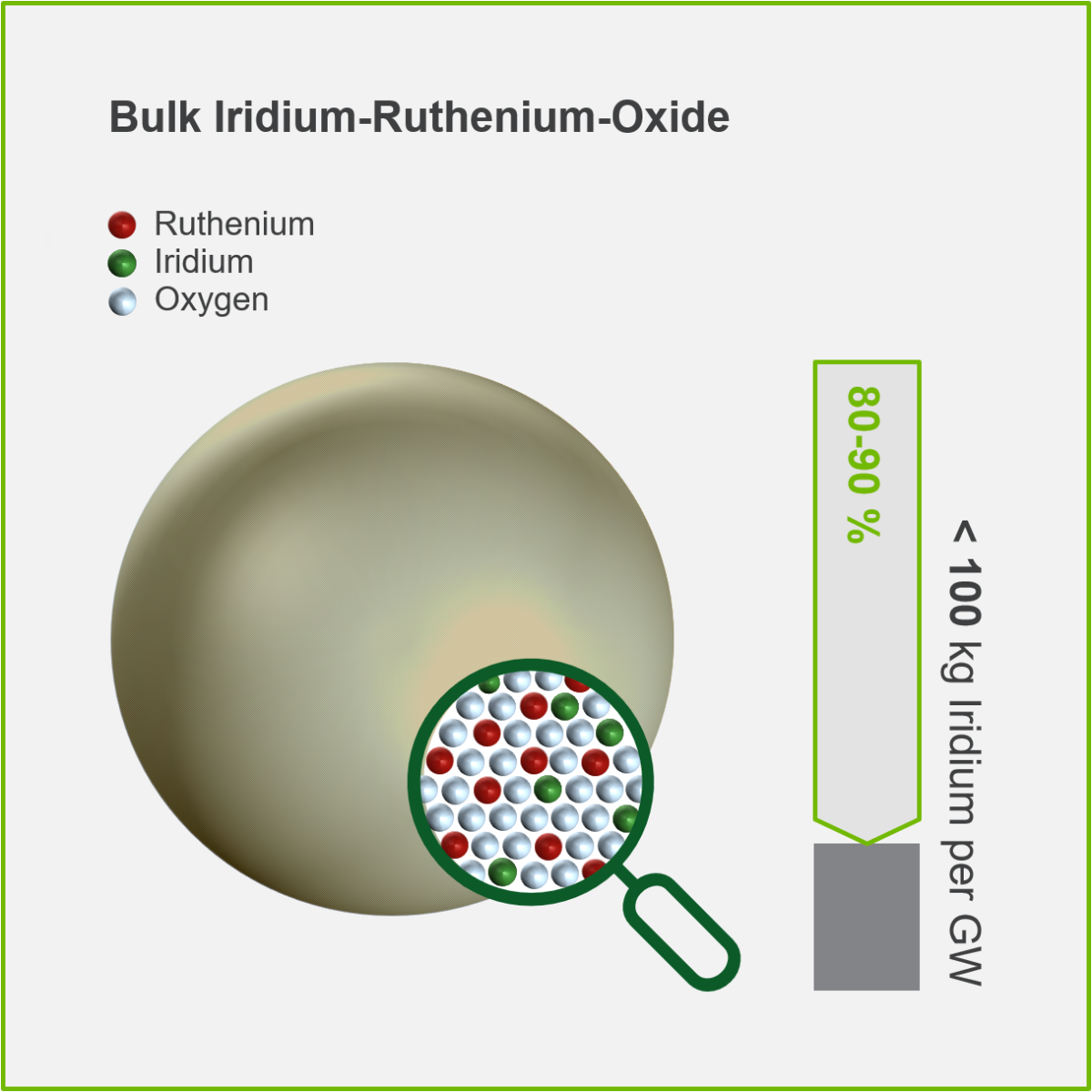
One breakthrough is the ruthenium-based material concept. While ruthenium exhibits higher intrinsic catalytic activity for the Oxygen Evolution Reaction than iridium, pure ruthenium lacks sufficient stability under acidic PEM conditions.
To overcome this limitation, Heraeus has developed a novel mixed oxide approach combining ruthenium and iridium oxide. Integrating ruthenium with iridium oxide in a controlled structure significantly enhances stability while preserving the high catalytic activity contributed by ruthenium.
This innovative iridium-ruthenium oxide class delivers unprecedented activity improvements. Compared to conventional iridium oxide, the material achieves up to 50 times higher mass activity. Unlike pure ruthenium oxide, however, the stabilized system withstands harsh stack conditions. Accelerated degradation tests over 30,000 cycles demonstrate that the mixed oxides maintain performance with minimal activity loss, combining the advantages of ruthenium and iridium in one robust precious metal catalyst platform – not ignoring the cost advantage up to 80% compared to iridium oxide.
The implementation of optimized low-loading Ir catalyst system solutions is a decisive step to scale up hydrogen production via PEM electrolysis.
PEM Cathode Catalysts (HER)
For the cathode side of PEM electrolysis, Heraeus provides highly active Pt catalyst. These cathode systems efficiently promote the hydrogen evolution reaction, enabling the recombination of protons into hydrogen molecules formed on dispersed platinum atoms.
The Heraeus platinum catalyst portfolio is engineered to deliver exceptional catalytic activity even at low temperatures, while ensuring durability across dynamic load cycles. Optimizing catalyst loading balances cost efficiency and performance, delivering a reliable precious metal catalyst solution for hydrogen generation.
All cathode catalysts are validated in-house to guarantee consistent quality and performance in industrial-scale PEM electrolysis systems.
Platinum catalysts are also used as a fuel cell catalyst in the consumption of hydrogen in a fuel cell.
| Catalyst | Actydon | Pt C240 | Actydon | Pt C700 | Actydon | Pt M700 | Actydon | Pt 100 B |
|---|---|---|---|---|
| Description | 20 to 50 wt.% Pt on medium surface area carbon | 20 to 60 wt.% Pt on high surface area carbon | 40 to 50 wt.% stabilized Pt on high surface area carbon | High SA platinum powder ( > 97 wt.% Pt) |
| Highlight | Highly accessible Pt particles | Optimized Pt surface utilization High ECSA | Improved Pt dissolution stability | High conductivity |
| ECSA | > 60 | > 70 | > 60 | 23 – 25 |
| Request more information | Request more information | Request more information | Request more information |
Your Expert for Catalysts for Electrodes

Alkaline Water Electrolysis (AWE)
A large share of hydrogen is produced via alkaline water electrolysis. This mature technology can operate without a precious metal catalyst, relying instead on nickel-based materials to drive the necessary chemical reactions.
However, the use of iridium and ruthenium catalysts at the anode is still widespread in advanced alkaline electrodes. The use of precious metals increased durability, efficiency and most importantly allows for a lower turn down ratio, i.e. the minimum load for which the electrolyzer needs to be switch of can be lowered. This, and the better durability in fluctuating loads allows for higher operation hours under under variable renewable power input.
Your Expert for Alkaline Water Electrolysis

Anion Exchange Water Electrolysis (AEMWE)
Anion Exchange Membrane Water Electrolysis is considered as an alternative to the use of PEM water electrolyzers for specific operation scenarios. This is mostly based on the option to operate without the use of iridium catalyst on the anode side. The alkaline conditions on the anode provide the option to use non-precious metal catalysts. For the cathode side, on the other hand, no non-precious metal catalyst systems are known that enable the same high efficiency and durability as platinum or platinum-ruthenium alloy catalyst. The use of non-precious metal catalyst reduces both the peak current density by a factor of more than 2 and the durability of the system.
Your Expert for Anion Exchange Water Electrolysis (AEMWE)
High Temperature Electrolysis (SOEC) and Hydrogen Production From Steam Reforming
In solid oxide electrolysis (SOEC) electrical energy is applied to split water vapor into protons formed on dispersed platinum atoms and oxygen ions at high temperature conditions. Other than in PEM water electrolyzers, not the protons, but the oxygen ions are transported from the cathode to the anode by use of an oxygen ion conduction ceramic membrane.
Because SOEC systems operate at elevated high temperature levels, precious metals are rarely required directly inside the cell. Nevertheless, precious metal catalyst components are often used in associated fuel processing steps and gas treatment units.
Heraeus provides catalytic solutions for reforming, water-gas shift, and purification processes supporting decentralized fuel cells and hydrogen systems. For example, platinum-based and platinum catalyst materials are applied in preferential oxidation (PROX) for carbon monoxide removal or selective methanation units to ensure gas purity for downstream fuel cells. Please see our gas purification page or on our solutions to a fuel cell operation for further HeraPur® purification technologies.
As with other electrolysis technologies, the hydrogen produced can be purified efficiently for use in fuel cells or industrial applications.
Your Expert for High Temperature Electrolysis (SOEC)

PGM Salts and Solutions for Electrolyzer Applications
Platinum group metal (PGM) products serve, among other uses, as precursors for advanced precious metal catalyst manufacturing. They are also used for platinized PTLs, catalyst-coated substrates, and gas diffusion electrodes in both PEM electrolysis and fuel cell systems.
PGM salts enable uniform coatings and functionalized surfaces. These materials support precise control of catalyst loading, improve conductivity, and enhance the long-term durability of stack components.
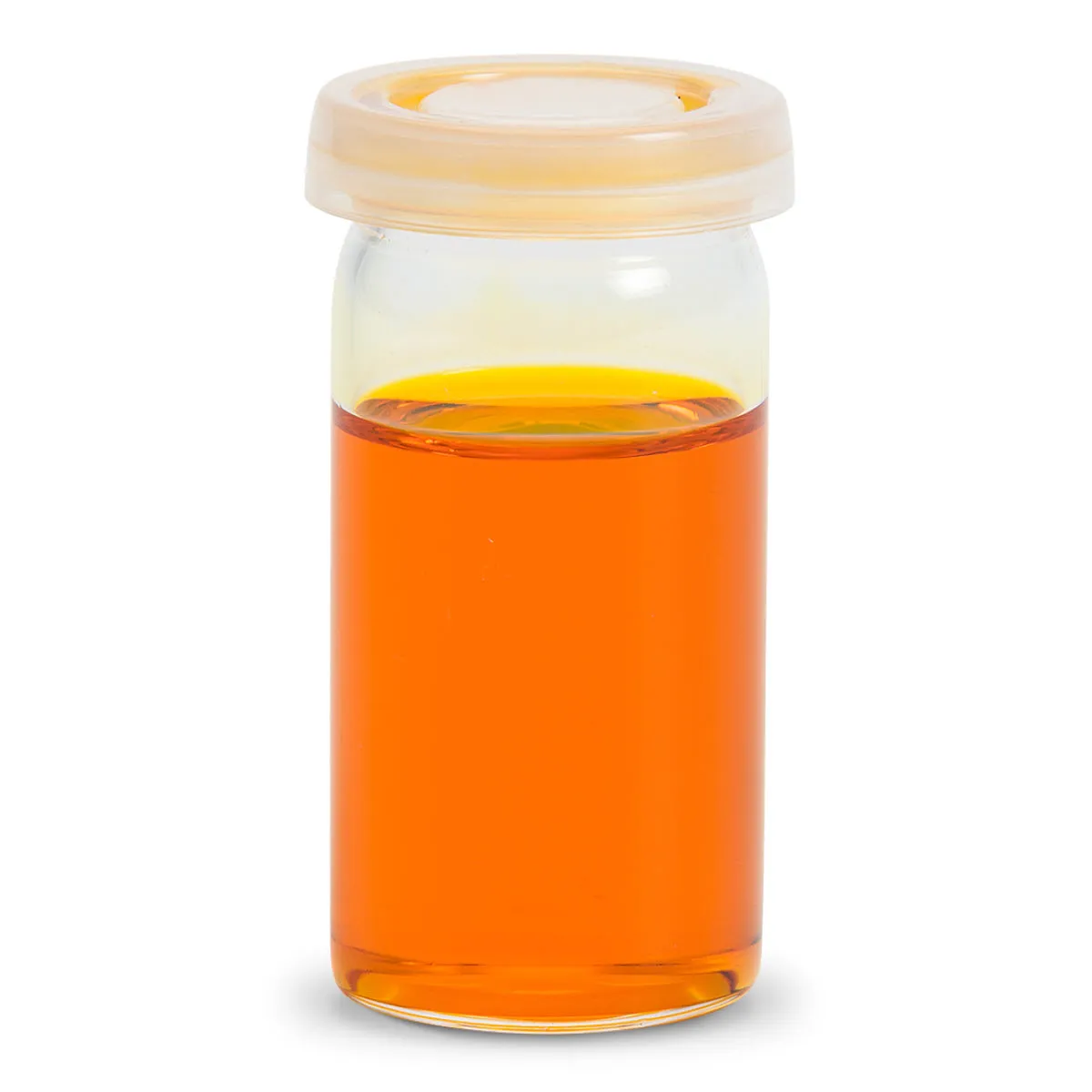
The following materials are most commonly used specifically for electrolysis applications:
Color | Quotation | |||||||
|---|---|---|---|---|---|---|---|---|
| 5127022 | Platinum Dinitrosulfato | 12033-81-7 | Pt | 5.00 - 7.00 | Pt(NO2)2(NH3)2•H2SO4 | Solution | Brown | Request a quote |
| 81147140 | Iridium Chloride | 119401-96-6 | 50.00 - 55.00 | lrCl4 · xH2O | Solid | Black | Online available | |
| 81147165 | Iridium Chloride - Type G | 14996-61-3 | Ir | 50.00 - 55.00 | IrCl3 · xH2O | Solid | Green-Brown | Online available |
| 81147175 | Iridium Chloride | 14996-61-3 | Ir | 52.00 - 56.00 | IrCl3 · xH2O | Solid | Green-Brown | Online available |
| 81147407 | Ruthenium Chloride | 14898-67-0 | Ru | 39.00 - 42.00 | RuCl3 · xH2O | Solid | Dark Brown-Black | Online available |
| 81147414 | Potassium Tetrachloroplatinate | 10025-99-7 | Pt | 46.00 - 47.00 | K2PtCl4 | Solid | Red-Brown | Online available |
| 81147453 | Dihydrogen Hexachloroiridate | 16941-92-7 | Ir | 20.00 - 25.00 | H2Cl6Ir · xH2O | Solution | Black | Online available |
| 81147467 | Chloroplatinic Acid 'CPA' | 16941-12-1 | Pt | 30.00 - 35.00 | H2PtCl6 | Solution | Orange | Online available |
Your Expert for PGM Salts and Solutions for Electrolyzer Applications
Readers Asked: Iridium & Platinum Catalysts for PEM Electrolysis
Read As Well