Hydrogen Purification Catalysts - HeraPur ®
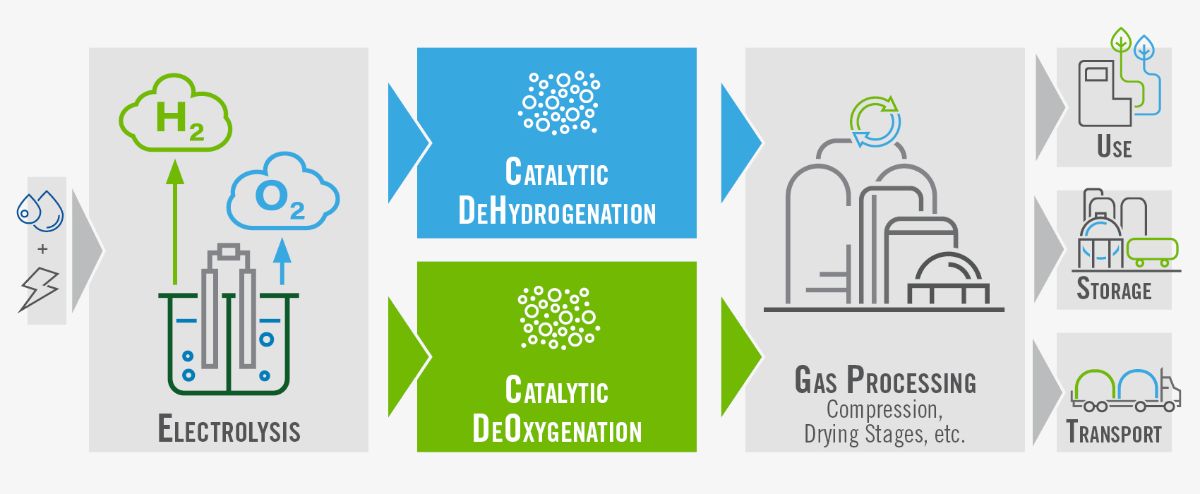
The splitting of water by electrolysis is an efficient technology to produce hydrogen and oxygen. Alternatively, hydrogen is commonly produced by steam reforming. However, either way, for a further use the gases must be separated and purified. Depending on the applied technology hydrogen purification catalysts are required to remove oxygen after electrolysis (De-Oxo catalyst) or to increase hydrogen yield and reduce carbon monoxide through the water-gas shift reaction (WGS) and subsequent CO abatement (PROX, Methanation) after steam reforming to increase hydrogen yield.
Hydrogen purification catalysts are used throughout the entire hydrogen value chain, from hydrogen production and gas conditioning to storage, transport, and fuel cell applications.

De-Oxo Catalysts: Removal of Oxygen From Hydrogen After Electrolysis
Deoxygenation, or De-Oxo, is the process of removing trace amounts of oxygen from hydrogen or inert gas streams through the reaction of oxygen and hydrogen forming water.
Why Is Oxygen Removal Necessary After PEM Electrolysis?
In PEM electrolysis, the separation of hydrogen and oxygen is not fully perfect. Small amounts of oxygen remain in the hydrogen gas stream, while hydrogen can slip into the oxygen side. This gas crossover varies with operating conditions and can increase over time.
As a result, hydrogen purification after electrolysis and oxygen removal from hydrogen in particular is required as a core step in downstream gas treatment. Oxygen concentrations in hydrogen can reach low single-digit percent levels, while hydrogen slip typically ranges from a few hundred ppm to several thousand ppm over the system’s lifetime.
These impurities must be removed before further processing. Oxygen in hydrogen gas creates safety risks by forming combustible mixtures, especially during compression, storage, and transport.
Oxygen also impacts performance. It can reduce compression efficiency and damage sensitive components in fuel cells, accelerating degradation.
Hydrogen purification for fuel cell applications must meet strict standards such as ISO 14687or Grade D hydrogen.
How Is Oxygen Removed From Hydrogen After Electrolysis?
Oxygen is removed from hydrogen after electrolysis by catalytic hydrogen purification. A De-Oxo catalyst enables the reaction of oxygen with hydrogen gas to form water (O2 + H2 → H2O), even at low temperatures.
Oxygen is first converted into water in a fixed bed reactor, followed by a drying step to remove the formed moisture. This results in the application of a hydrogen drying and deoxygenation system (a Hydrogen De-Oxo-Dryer) with combined process removal of moisture and oxygen impurities. The catalytic operation is possible to run at low temperatures, with the dew point limiting the low-temperature performance as condensation in the catalyst bed must be avoided.
Heraeus HeraPur® gas purification catalysts enable efficient low-temperature operation in hydrogen dryer systems. New catalyst generations support modern electrolysis systems with reduced precious metal content and stable performance.
De-Oxo Catalysts Portfolio
The Heraeus hydrogen purification catalyst portfolio offers the right solution for your purification requirements.
Form | Markets | Details | ||||
|---|---|---|---|---|---|---|
| 89611001 | K-0140-03 | 0.3% Platinum, Alumina | Pt 0.3% | Pellets | Gas Purification | Details |
| 89611005 | K-0140-05 | 0.5% Platinum, Alumina | Pt 0.5% | Pellets | Gas Purification | Details |
| 89610152 | K-0152-01 | 0.1% Platinum, Alumina | Pt 0.1% | Spheres | Gas Purification | Details |
| 5036096 | K-0152-02 | 0.2% Platinum, Alumina | Pt 0.2% | Spheres | Gas Purification | Details |
| 89610153 | K-0152-03 | 0.3% Platinum, Alumina | Pt 0.3% | Spheres | Gas Purification | Details |
| 89602130 | K-02130 | 0.15% Palladium, 0.15% Platinum, Alumina | Pd 0.15% Pt 0.15% | Spheres | Gas Purification | Details |
| 89602133 | K-02133-05 | 0.5% Palladium, Alumina | Pd 0.5% | Spheres | Gas Purification | Details |
| 89610001 | K-0240-01 | 0.1% Palladium, Alumina | Pd 0.1% | Pellets | Gas Purification | Details |
| 89610003 | K-0240-03 | 0.3% Palladium, Alumina | Pd 0.3% | Pellets | Gas Purification | Details |
| 89610005 | K-0240-05 | 0.5% Palladium, Alumina | Pd 0.5% | Pellets | Gas Purification | Details |
| 5160588 | K-0264-0,25 | 0.25% Palladium, Alumina | Pd 0.25% | Gas Purification | Details | |
| 89650267 | K-0264-02 | 0.2% Palladium, Alumina | Pd 0.2% | Spheres | Gas Purification | Details |
| 89650265 | K-0264-03 | 0.3% Palladium, Alumina | Pd 0.3% | Spheres | Gas Purification | Details |
| 89650264 | K-0264-05 | 0.5% Palladium, Alumina | Pd 0.5% | Spheres | Gas Purification | Details |
| 89611288 | K-0288 | 0.2% Palladium, 0.1% Platinum, Alumina | Pd 0.2% Pt 0.1% | Spheres | Gas Purification | Details |
CO Abatement Catalysts: Removal of CO From Hydrogen Produced by Steam Reforming
Steam reforming is a widely used process for hydrogen production in industrial and decentralized applications. In addition to hydrogen, the reformer gas yet still contains carbon monoxide, which reduces the hydrogen purity and must be removed for many downstream applications, particularly in fuel cells.
Water-gas-shift catalysts increase the yield and purity of reformate hydrogen by generating additional hydrogen while reducing the carbon monoxide concentration. Depending on the required gas quality, subsequent hydrogen purification and gas polishing are achieved using preferential oxidation catalysts (PROX) or selective methanation (SelMeth) catalysts to remove the remaining CO and produce industrial- or fuel cell-grade hydrogen.
Hydrogen Purification Portfolio for CO Abatement
The HeraPur® portfolio includes hydrogen purification catalysts for every stage of CO removal in reforming processes, particularly for demanding industrial and decentralized hydrogen production. The portfolio includes:
- chromium-free medium-temperature water-gas shift (WGS) catalysts
- low-temperature WGS catalysts with low light-off temperatures
- PROX catalysts for preferential CO oxidation
- methanation catalysts
- highly selective CO methanation catalysts
Based on provided process conditions, impurity profile, and purification targets, Heraeus supports the client to identify the most suitable catalyst solution for efficient syngas purification and CO removal.
Various sources can be used to generate hydrogen, and the resulting impurities highly depend on the source process used. Other impurities will also need a different hydrogen purification catalyst. The complete HeraPur® gas purification catalyst portfolio offers you a comprehensive selection and the right catalyst also for your specific setting.
Read As Well


Get In Touch